
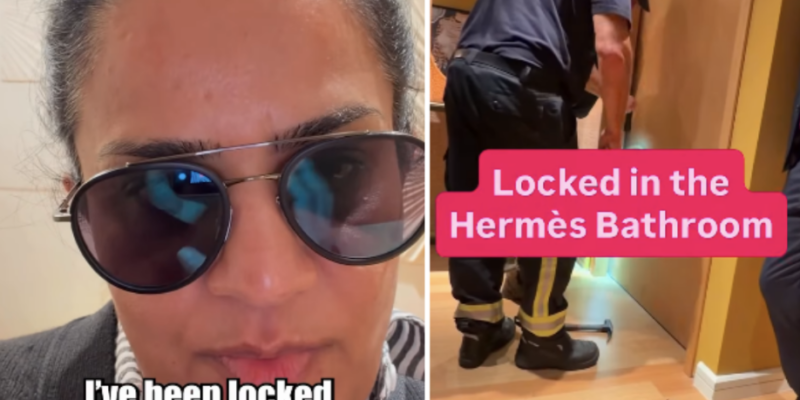
A broken bathroom door should have been a minor operational embarrassment for Hermès. Instead, it became an example of how a small failure can metastasise when the apology never arrives.
Comedian and New York Times bestselling author Zarna Garg says she was trapped inside the bathroom of the luxury brand’s Berlin store for more than an hour last week
And for Hermès, there was one further complication: the entire debacle had witnesses, footage and a narrator with two million followers across social media.
Garg posted footage from inside the bathroom and documented her interactions with staff after she was eventually freed. According to Garg, staff acknowledged the door had jammed previously, yet there was no warning telling customers not to use it.
Watching the footage, the priorities appear badly inverted: the staff seem more solicitous of the door than of the woman trapped behind it. The fire brigade wasn’t called until around 40 minutes into the ordeal, and requests to break the door were flatly denied.
Hermès had an obvious opportunity when Garg finally emerged from the bathroom. Apologise and check she was okay.
Instead, she was effectively blamed for closing a door staff already knew was faulty, then handed champagne instead of contrition. Champagne is not an apology, and in this context it risks looking less like hospitality than an attempt to paper over the absence of accountability.
Garg declined it, pointing out that she had spent more than an hour trapped in a bathroom and had still not received an apology. Then, when they were outside the store, a guard called out to Garg and her family to make a point of telling her that she knew the bathroom door was faulty, and then shut the store door while she was responding.
That final interaction outside the store compounded the original failure. By then, Hermès was no longer merely dealing with a broken door. It was dealing with a customer who felt blamed and dismissed.
There is a brief window after something goes wrong when an apology can still arrest the momentum of a story. Miss it, and people stop judging the incident. They start judging the organisation and its response. The first reputational battle is over what happened. The second is over how you responded. Hermès appears to have lost control of the second.
For Hermès, an immediate apology might have turned Garg’s story into an unfortunate but ultimately well-handled customer service incident.
Imagine if, shortly after she left the store, Garg had posted an update saying a senior Hermès executive had called her personally, apologised without qualification, checked on her and her daughters and confirmed the faulty bathroom had been closed for repair.
The lesson for any business is the longer you wait, the more an apology has to achieve. Delay does not neutralise the problem; it compounds the debt. By that point, the apology is no longer addressing one failure, but addressing the original incident, the mishandling, the silence and the growing perception that the organisation had to be dragged towards accountability.
And eventually, people start wondering whether you’re apologising because you’re sorry or because the story has become too damaging to ignore.
The other reason this incident is awkward for Hermès is that for a luxury house, the service experience is not peripheral to the product. It is part of the product.
Hermès has spent decades cultivating an image built around exceptional service, exclusivity and attention to detail.
If I were advising Hermès, my first recommendation would be unequivocal: a genuinely senior executive should call Garg personally, today.
The apology should be unqualified, specific and human. It needs to acknowledge both what happened in the bathroom and the way the situation was handled afterwards. No euphemisms. No glib explanation. No attempt to explain the customer’s behaviour.
Hermès should also be able to explain what has changed – such as the bathroom being closed and the door fully replaced. Staff should also be trained in handling difficult customer interactions.
Brands can’t always control what goes wrong inside their businesses, but they do have far more control over what happens in the minutes and hours afterwards.
Perhaps Hermes could also take a note from JC Penney.
The US retailer, which already had a partnership with Garg, has expanded its work with her and is now promoting a giveaway offering a shopping experience with Garg, cheekily promising bathroom doors that don’t break.
JC Penney’s response is deft, topical and commercially opportunistic in the best sense. Hermès left a communications vacuum, and another brand stepped straight into it.
Hermès could still contain this. But every day it waits, the task becomes harder. A prompt apology might have closed the door on the story. Silence has left it wide open.