
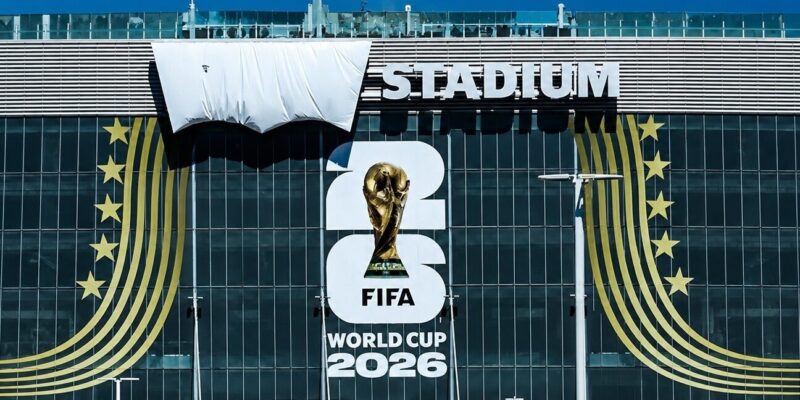
Levi’s Stadium in California is one of the venues hosting the FIFA World Cup. Or rather, it was, briefly, not Levi’s Stadium at all, because Levi’s is not an official FIFA sponsor. Under FIFA’s commercial rules, stadium branding must be covered and venues temporarily renamed during tournament play.
So FIFA told Levi’s its famous logo had to disappear.
But even with the logo covered up, you can still tell exactly what it is.
In fact, more people are looking at it now than when it was fully visible. Social media loved it. Media covered it. And Levi’s then leaned into the joke, changing its social media profile picture to the covered logo and referring to the venue as “[redacted] stadium”.
The result? FIFA may have generated more publicity for Levi’s than Levi’s would have received had the logo simply been left alone.
Visibility does not always come from exposure
Most organisations assume the two are the same. But sometimes visibility comes from restriction.
The moment somebody says, “You can’t show that,” people become interested in seeing it. The moment something is removed, we start looking for it. The story stops being about the thing itself and becomes about the attempt to hide it.
Levi’s understood that. Importantly, they did not complain. They did not attack FIFA. They did not create a public dispute. They simply complied in a way that made the restriction itself the story.
There is one critique worth raising, though, and it comes from our Head of Media, Kate McMahon: the covering material was plain white. Kate’s view, and it’s hard to disagree, is that the chef’s kiss version would have been giant denim. Imagine the logo wrapped in oversized Levi’s-style denim, complete with stitching and texture. At that point, every photograph of the stadium becomes an advertisement. But even without that masterstroke, the execution was brilliant.
What smaller brands can take from this
It is worth noting that this only works because Levi’s is already Levi’s. A white tarp over an unknown logo is just a white tarp. A white tarp over one of the world’s most recognisable brands becomes a joke everyone understands.
But smaller brands should not dismiss the lesson. The lesson is not “hide your logo”. The lesson is “turn a constraint into a story”.
Levi’s used a logo because they had decades of brand recognition to draw on. Most organisations do not have that luxury. What they do have are obstacles, limitations, budget constraints, setbacks and moments where somebody tells them no.
The best communicators know how to turn those moments into narratives. Because sometimes the thing standing in your way can become the most interesting part of the story. And that is exactly what Levi’s managed to do.